


👉 Available on Spotify, Apple Podcast, Deezer, and more.
Aboard Barge 166, the world's first floating cellar, our casks age to the rhythm of the Seine, rocked by the movement of the water. Moored on the doorstep of Paris, this fully restored 1948 barge is now home to more than 1,000 aging casks.
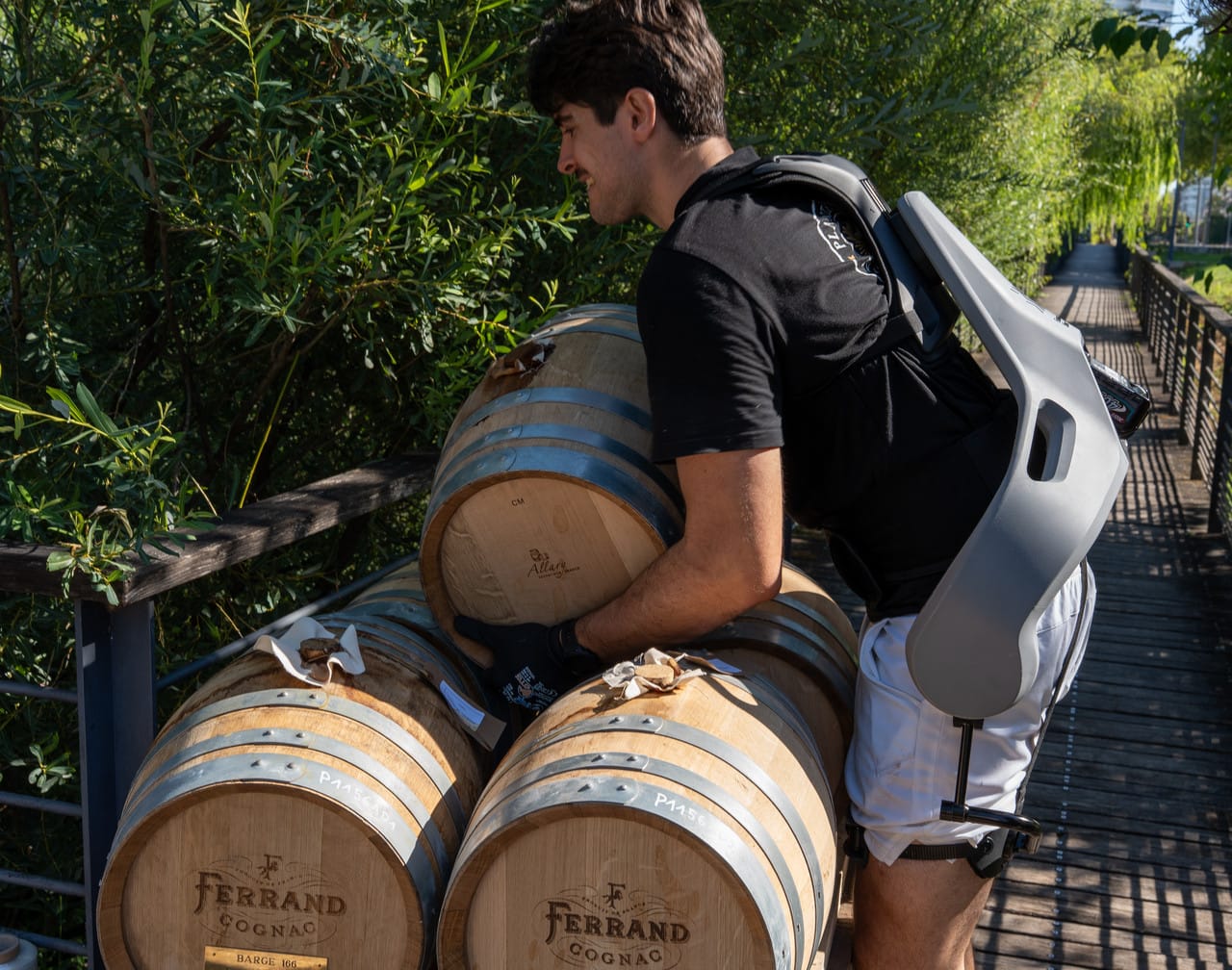
It's a one-of-a-kind setting, and it also means very physical work: day to day, our teams may have to move, lift and position several tons of casks. These tasks are essential in the cellar, but they're hard on the body, especially the back.
And as you know, at Ferrand we like to do things our own way. So when it comes to looking after our teams and making their days easier, we're happy to go off the beaten path. Even if it means giving them a superhero look!
Starting with real-world testing
To take things further, we brought in German Bionic, a specialist in active exoskeletons for professionals.
Before adopting the exoskeletons, our cellar teams tested them in real working conditions, aboard Barge 166. The idea was simple: see what the equipment really added to everyday tasks, check its comfort and effectiveness, and make sure it suited the demands of working around casks.
After the trial, we trained the teams involved to adjust the exoskeletons, handle them properly and work them naturally into their daily routine.
Here to help, not to replace
It's easy to picture an exoskeleton as something futuristic. In reality, its role is much simpler: to support movement.
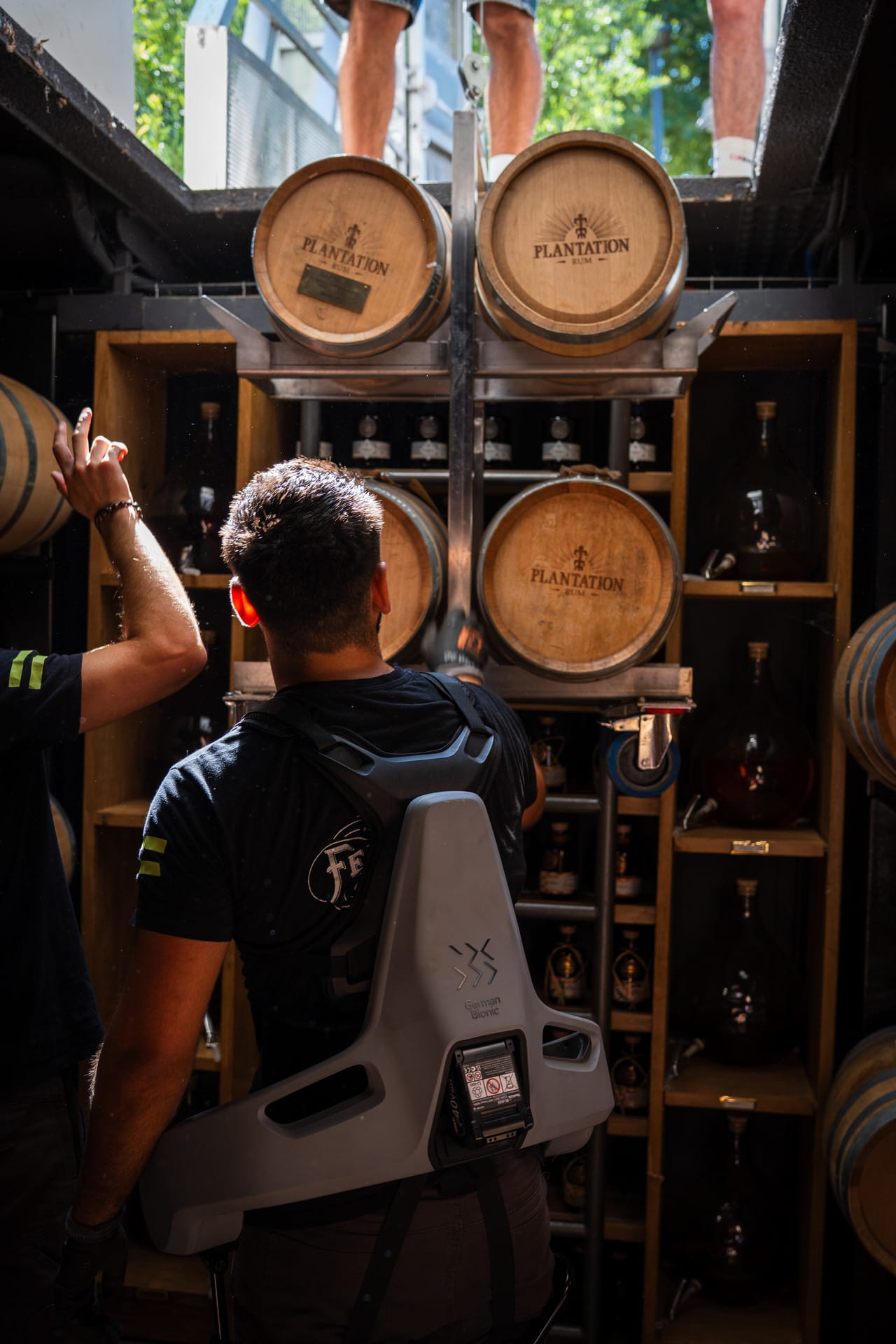
The model we use at Maison Ferrand is what's called an active exoskeleton. Two battery-powered motors, controlled by AI-driven software, assist the wearer when they bend down, stand back up or set down a load. According to German Bionic, the system can offset up to 38 kg (about 84 lb) of effort on the lower back.
The German Bionic team compares it to an e-bike: the rider keeps pedaling, but the motor helps out when the going gets tough. The exoskeleton works the same way. The wearer stays in control of the movement; the machine simply supports it.
"The exoskeleton doesn't replace people. It's there to assist. The goal is to support workers, help keep them safe and reduce the fatigue that comes with repetitive movements and carrying loads." - Brice Mauvieux, Sales Manager France, German Bionic
When a cask needs lifting, the assistance kicks in on the way up. When it needs setting down, the system can take on part of the effort and ease it down. Our teams can also use walking assistance when working on a slope or heading back up a pontoon. So, the goal isn't to let people carry more, it's quite the opposite. It's about reducing the physical strain of loads that are already part of the daily routine.
Adapting to each person
We also wanted different users to be able to share the same equipment, so the exoskeleton isn't assigned to just one person. Every Ferrand team member has their own settings and a fabric component fitted to their build. An individual profile also lets the system automatically recall each person's settings.
The equipment also has a built-in system that learns the wearer's movements and work habits, gradually adapting its assistance. The technology is shared, but the experience is personal!
Understanding the physical demands of the job
Beyond physical support, the trials also give us a closer look at the movements involved in the work. Among other things, the platform connected to the exoskeletons can count bends and twists and estimate how much effort was offset during a session. Health and safety teams or ergonomists can then use this data to better understand a workstation and spot possible improvements.
On Barge 166, we introduced the exoskeleton step by step: field tests, adjustments with our teams, and a rollout wherever it makes a real difference day to day.
A low-key innovation for the people who do the heavy lifting!


Member discussion